Key Takeaways
- •The math of recognition: 100 target accounts, 3 decision-makers per account = 300 people. 15 impressions per person per month = 4,500 impressions.
- •At ~$100 CPM = ~$450/month ad spend. For the cost of one team lunch, every decision-maker at your top 100 accounts sees your exec 15 times per month.
- •Two phases: Saturation (first 2 weeks, higher frequency to establish presence) then Maintenance (steady frequency to maintain recognition).
- •The goal isn't maximum impressions. It's sufficient frequency for recognition across your target accounts.
The Problem: Narrative Consistency
Most B2B ad campaigns fail because they lack Narrative Consistency.
You might have 5 great ads that tell a compelling story. But if your target accounts see Ad #3, then Ad #1, then nothing for a month, you haven't told a story. You've just created noise.
Reach is meaningless if it's random.
To build influence, you need to control the sequence of consumption. You need to ensure that your target audience—the entire buying committee—is moving through your narrative journey together.
The Goal: 70% Audience Penetration
This is the core metric we use at Ampy. It refers to the percentage of your matched audience segment that has been exposed to a specific piece of content.
The Rule
We do not rotate to the next message until the current one has reached 70% Audience Penetration.
Why? Because if you switch messages too early, you leave half your audience behind. You end up with a fragmented market: some people know your problem statement, others only know your pricing, and no one understands your full value.
The Strategy: The "Frequency Squeeze"
How do you guarantee this 70% penetration without taking months? You use a dynamic frequency strategy we call the Frequency Squeeze.
It solves the tension between "getting seen" and "being annoying."
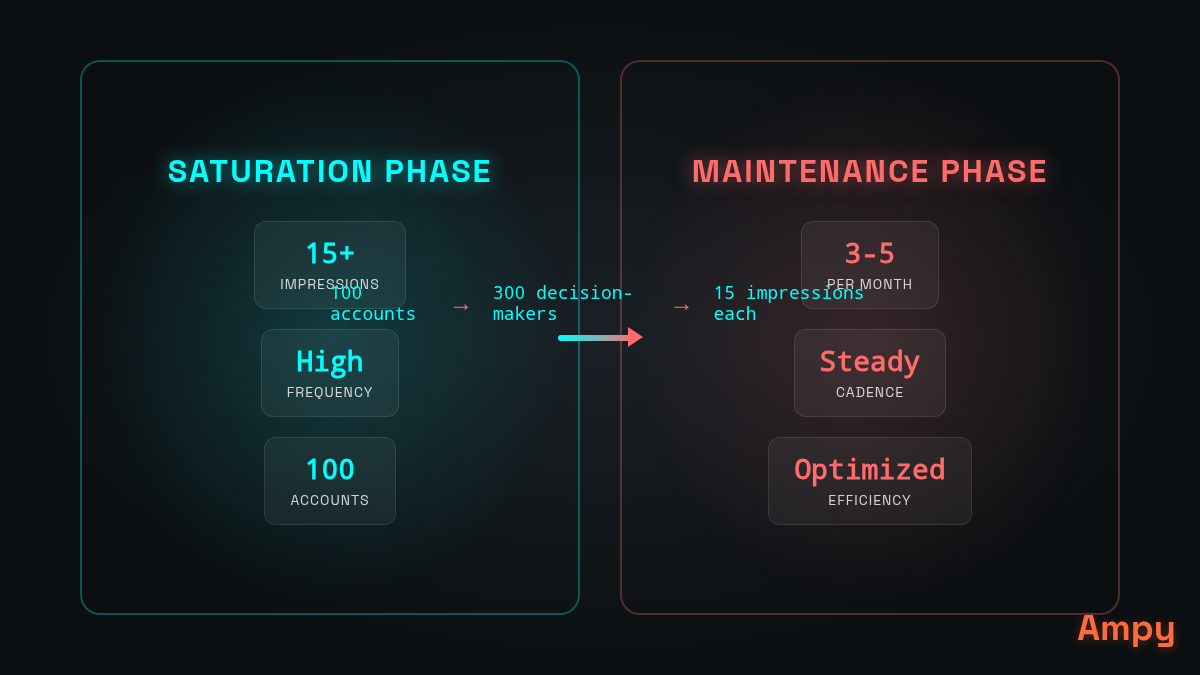
⚡Phase 1: Saturation (The Sprint)
SETTING
30 Imps / 7 Days
When we launch a new Episode, we set frequency high to break through the noise.
GOAL
70% Audience Penetration
We are "sprinting" to get 70% of the audience to see this chapter of the story.
📊Phase 2: Maintenance (The Marathon)
SETTING
3 Imps / 7 Days
As soon as 70% is met, we drop frequency drastically. We don't stop the ad, we just lower the volume.
GOAL
Retention & Alignment
Maintain share of mind while budget is freed up for Episode 2.
The Result: A Sequenced Cohort
By automating this squeeze for every single episode, you create a "Rolling Cohort" effect:
Episode 1: The Problem
Audience is saturated with the problem statement.
Episode 2: The Solution
As Ep 1 moves to maintenance, the audience is saturated with your solution.
Episode 3: Social Proof
As Ep 2 moves to maintenance, the audience is saturated with proof points.
Instead of a scattered mess of impressions, you have a synchronized audience moving through a clear, logical story.
Automating the Journey
Doing this manually is impossible. You can't log in daily to check "Audience Penetration" rates for every campaign and toggle frequency caps by hand.
Ampy automates this entire workflow. We track the penetration metric in real-time. When the 70% trigger is hit, we automatically squeeze the frequency and queue the next episode.
You simply write the story. We ensure they read it in order.
Frequently Asked Questions
What is the difference between reach and account penetration?
Reach measures how many people saw your content at least once. Account penetration measures how deeply you've influenced a specific target account - including frequency per decision-maker and narrative progression. You can have high reach but zero penetration if your impressions are scattered randomly across non-target accounts.
Why do you use 70% as the threshold for narrative progression?
If you advance to Episode 2 when only 30% of your audience has seen Episode 1, then 70% of your target accounts will encounter your narrative out of sequence. The 70% threshold ensures most of your audience experiences your story in the correct order, building context progressively.
How long does it typically take to achieve 70% penetration?
With the Frequency Squeeze strategy (30 impressions per 7 days during saturation phase), most accounts achieve 70% penetration within 10-14 days for a single episode. The exact timing depends on your audience size and budget allocation.
Can this strategy work with smaller budgets?
Yes. The Frequency Squeeze is about efficient frequency distribution, not total spend. A $450/month budget can effectively penetrate 100 target accounts. The key is concentrating your spend on fewer, higher-value accounts rather than spreading it thin across thousands of impressions.
How do you measure narrative consistency manually?
Export impression data from your ad platform, cross-reference with your target account list, and track episode-level exposure per account. However, this is extremely time-intensive and doesn't guarantee sequential delivery. Automated systems like Ampy track this in real-time.
Ready to Sequence Your Story?
Stop burning budget on random reach. Let Ampy manage your narrative journey automatically.
Get early access to Mission Control
One email. We'll reach out when your seat is ready.
Related Articles
Story Arc Methodology: The 7-Episode Framework for Sequenced LinkedIn Ads
A Story Arc is 5-7 posts delivered in sequence to the same target accounts. Learn the framework for turning exec content into recognition-building campaigns.
Measuring Account Penetration: The North Star Metric for ABM
How to calculate and track account penetration across your target account lists. Learn the metrics that predict ABM success.
Account Penetration Strategy: The B2B Marketer's Guide
Account penetration measures how many people you're reaching within target accounts. Learn strategies to increase your penetration and drive more pipeline.
Karl Newlin
Founder & CEO, Ampy
Karl has spent 12+ years in B2B growth marketing — including roles at Upwork, Gusto, Carta, Step, Stripe, and Mutiny — where he saw the same distribution problem over and over: great content, zero orchestration. He built Ampy to fix that.