Key Takeaways
- •DIY B2B distribution isn't one task — it's a stack of five specialized skills (audience targeting, creative production, platform mechanics, measurement, optimization) that each take months to learn properly.
- •The learning curve tax costs both time and money: 3-5 months to reach stable campaign performance, plus 30-40% higher cost per lead during the ramp period.
- •Five operational gaps kill DIY distribution: sequencing, frequency management, cross-platform coordination, measurement that works, and creative velocity. Solving these requires specialized infrastructure.
- •When you factor in wasted ad spend, founder opportunity cost, and pipeline not built during learning months, DIY typically costs 5-8x more per qualified lead than partnering with experienced operators.
The DIY Temptation
TL;DR: Most B2B founders default to DIY distribution because it feels free. It isn't. The hidden cost is the months of pipeline you don't build while you're still figuring out the basics.
DIY B2B distribution is the default choice for most founders, and it makes total sense on paper. You already know your product better than anyone. You're scrappy. You've bootstrapped this far. Why pay someone else to do what you could learn yourself?
I've watched this play out hundreds of times across twelve years in growth marketing — at Gusto, at Carta (where I helped grow from $30M to $150M ARR), at Step (where we built paid media from zero to $800K per month), and running $30M+ in budget at Stripe. The pattern is always the same: a founder decides to handle distribution themselves, spends three to six months in the learning curve, and either burns through budget learning expensive lessons or simply runs out of time before traction shows up.
This article is not here to tell you that DIY is always wrong. Sometimes it's the right call. But if you're going to make that bet, you should know exactly what you're signing up for — because the gap between planning to run distribution and actually running it well is where most B2B pipeline goes to die.
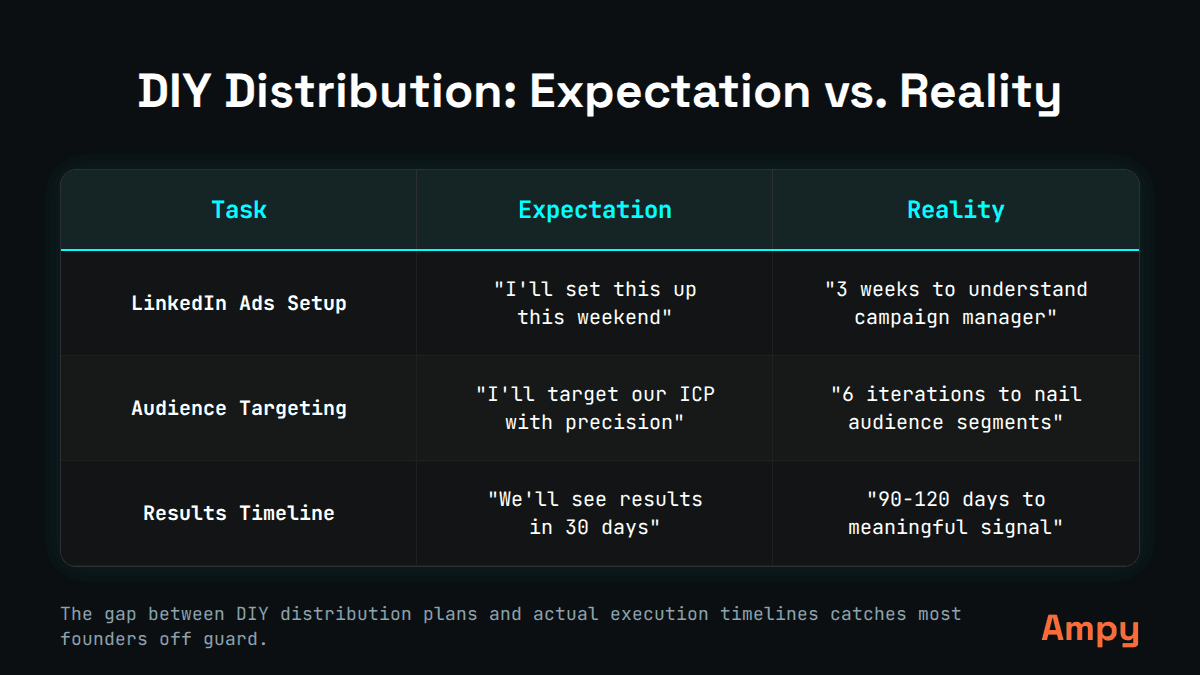
The gap between DIY distribution plans and actual execution timelines catches most founders off guard.
What DIY B2B Distribution Actually Looks Like
TL;DR: DIY distribution isn't one task — it's a stack of specialized skills (audience targeting, creative production, platform mechanics, measurement, optimization) that each take months to learn properly.
Most people think of "running distribution" as a single activity. Set up some LinkedIn ads, maybe run Google campaigns, push content to your website. One task, one person, a few hours a week.
In practice, B2B distribution across LinkedIn, Google, and Meta is at least five distinct skill sets:
1. Audience architecture. Building and maintaining target account lists, syncing them across platforms, segmenting by buying stage. On LinkedIn alone, the difference between a well-structured audience and a sloppy one can be a 3-4x swing in cost per result.
2. Creative production. Not just making ads — making ads that work in sequence. A single static image is different from a Story Arc that moves a buyer from problem-aware to solution-ready over four to seven weeks.
3. Platform mechanics. Each ad platform has its own bidding logic, auction dynamics, placement rules, and reporting quirks. LinkedIn's Campaign Manager alone has enough complexity to keep a full-time specialist busy. Our LinkedIn Campaign Manager comparison breaks this down in detail.
4. Measurement and attribution. Figuring out what's actually working when your sales cycle is 60-90 days and buyers touch twelve to fifteen pieces of content before a demo request. HubSpot's 2025 State of Marketing report found that 74% of B2B marketers say proving ROI is their top challenge.
5. Ongoing optimization. Campaigns aren't set-and-forget. They need weekly budget reallocation, creative refreshes, audience refinement. The median B2B campaign that isn't actively managed sees performance decay of 15-20% per month.
When a founder says "I'll do distribution myself," they're really saying "I'll learn five specialized disciplines simultaneously while also running my company." That's not impossible. But it's worth being honest about the scope.
The Learning Curve Tax
TL;DR: Every hour a founder spends learning distribution mechanics is an hour not spent on product, sales, or fundraising. This opportunity cost compounds fast — and the learning curve itself costs real ad dollars in wasted spend.
The thing about doing it yourself is that there's a learning curve. And that learning curve costs one of two things: time or money. Usually both.
I've spent over a decade inside B2B ad platforms. When I set up a new LinkedIn campaign, I know which bid strategies work for awareness vs. conversion objectives, how to structure audience exclusions to avoid waste, and what creative formats perform best at each stage of a Story Arc. That knowledge didn't come from a course. It came from managing tens of millions in spend and seeing thousands of campaigns play out.
A founder starting from scratch is going to spend:
- 2-4 weeks just understanding LinkedIn Campaign Manager's interface, objective types, and targeting options
- 4-8 weeks running initial campaigns and collecting enough data to know what's working (LinkedIn recommends a minimum of $5,000-$10,000 to exit the learning phase on a new campaign)
- Another 4-8 weeks iterating on creative, audiences, and bidding before hitting any kind of efficiency
That's three to five months before you have a stable, performing distribution engine. And during those months, you're paying full platform rates while generating below-average results. Forrester's 2024 B2B Marketing Survey found that companies without dedicated media expertise pay 30-40% more per qualified lead than those with experienced operators.
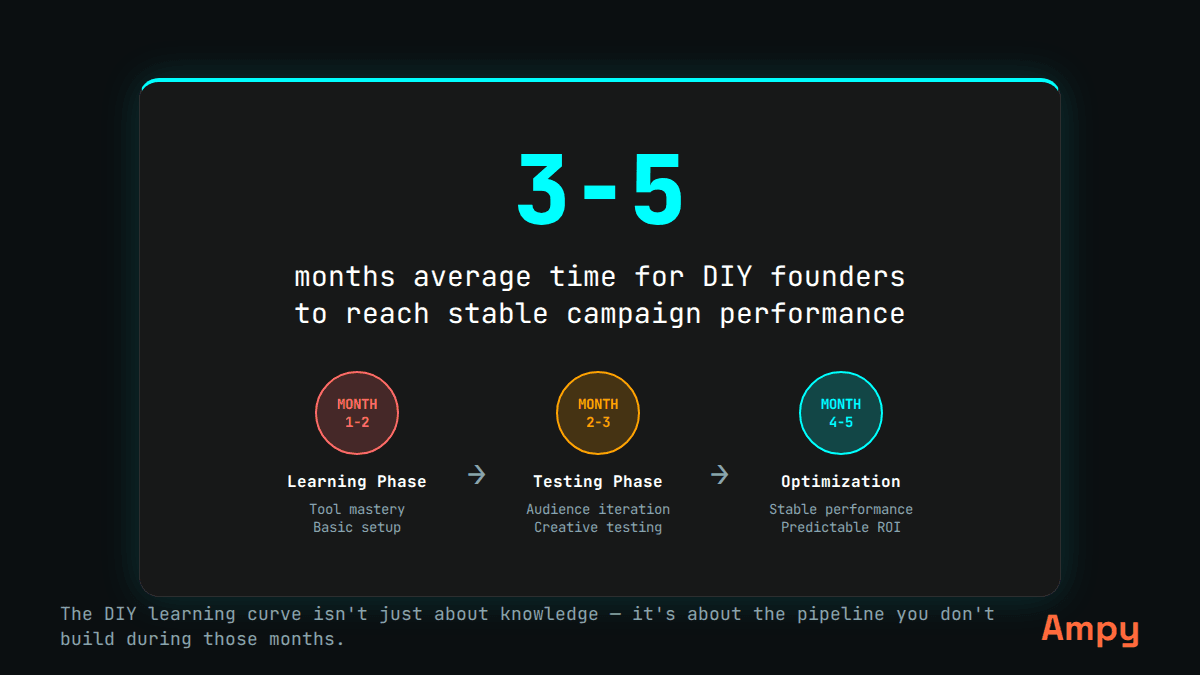
The DIY learning curve isn't just about knowledge — it's about the pipeline you don't build during those months.
The real tax isn't just the wasted ad spend. It's the opportunity cost. Every hour you spend troubleshooting LinkedIn's conversion tracking pixel is an hour you're not spending on product development, sales conversations, or fundraising. For a Series A founder, that time is worth somewhere between $500-$1,000 per hour when you factor in equity dilution and growth velocity.
Going with somebody who's done it before — who already knows how to do it — compresses that timeline from months to weeks. That's not a sales pitch. It's math.
The Five Gaps Between Intention and Execution
TL;DR: DIY distribution fails not because founders lack intelligence, but because five specific operational gaps — sequencing, frequency management, cross-platform coordination, measurement, and creative velocity — require specialized infrastructure that doesn't exist in a spreadsheet.
Smart founders don't fail at distribution because they're not capable. They fail because the gap between knowing what to do and having the systems to do it consistently is enormous. Here are the five places where DIY breaks down most often:
Gap 1: Sequencing
Most DIY distribution runs every ad in parallel. Same audience sees the same mix of messages in random order. But B2B buying isn't random — it follows a progression from problem recognition to solution evaluation to vendor selection.
This is where the Recognition Equation matters: Recognition = Reach × Frequency × Sequence. You need all three. Reach without frequency is invisible. Frequency without sequence is annoying. Sequence without reach is a whisper in an empty room.
Running sequenced campaigns manually is technically possible on LinkedIn. In practice, it requires building custom audience segments for each stage, setting up exclusion logic so people advance through the sequence, and monitoring progression rates daily. I've built these systems from scratch — at Carta, at Step, at Stripe. Each time, it took weeks of setup and constant maintenance. Most founders abandon the effort after two weeks because the operational overhead chokes out everything else.
Gap 2: Frequency Management
LinkedIn's self-serve tools give you almost no control over how often a specific person sees your ads. You can set daily budgets, but you can't say "show this person three ads per week, no more." The result: some prospects see your ad twenty times in a week (wasted budget, ad fatigue) while others see it once and forget you exist.
This is what we call the Frequency Squeeze — the problem of getting the right number of impressions to the right accounts without over-saturating or under-delivering. Solving it manually requires daily bid adjustments and audience micro-segmentation that most founders simply don't have time for.
Gap 3: Cross-Platform Coordination
Your buyers aren't only on LinkedIn. They're searching on Google, scrolling Meta, visiting your website. Coordinating messaging and sequencing across three or four platforms — making sure the same account sees a consistent narrative regardless of channel — is an infrastructure problem, not a knowledge problem.
Gap 4: Measurement That Actually Works
Google Analytics tells you where traffic came from. It doesn't tell you which sequence of touchpoints drove a deal. LinkedIn's built-in reporting attributes conversions to the last click, which misses 80% of the story in a B2B buying cycle. Gartner's 2025 B2B Buying Journey report found that the average B2B purchase involves 11-15 stakeholders and 27+ touchpoints. Tracking that in a spreadsheet is a fantasy.
Gap 5: Creative Velocity
B2B distribution needs fresh creative — new angles, new formats, new copy — on a regular cycle. Most DIY operators start strong with three or four ad variants, then run the same creative for months as it slowly decays. LinkedIn's internal data shows that creative refresh rates correlate directly with sustained engagement: campaigns that refresh creative every 4-6 weeks see 20-30% better performance than those running static creative.
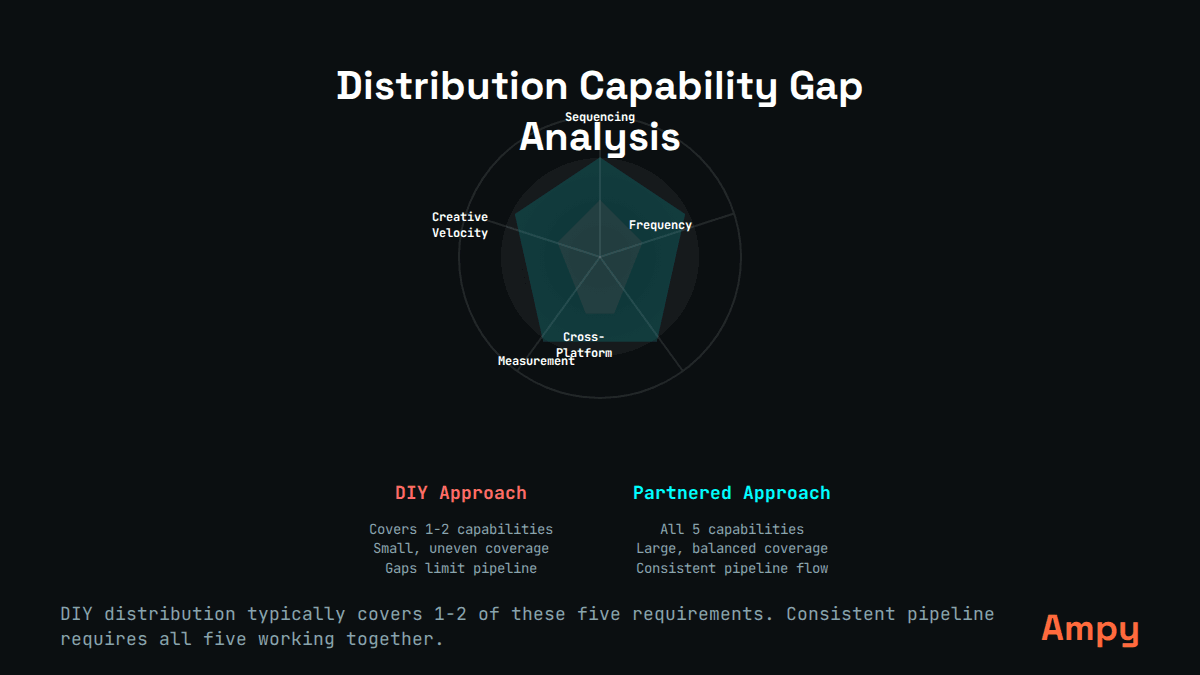
DIY distribution typically covers 1-2 of these five requirements. Consistent pipeline requires all five working together.
Why Recognition Requires More Than Willpower
TL;DR: B2B buyers don't choose the best product — they choose the name they recognize. Building that recognition requires sustained, sequenced exposure that DIY setups almost never maintain long enough to achieve.
Here's the uncomfortable truth about B2B buying: the best product doesn't always win. The most recognized product wins. Ehrenberg-Bass Institute research has shown for decades that brand salience — being the name that comes to mind when a buyer has a need — is the single strongest predictor of purchase behavior.
Recognition in B2B isn't built by running ads for two weeks and checking the pipeline. It's built by showing up consistently, in sequence, across channels, for months. The Recognition Equation — Recognition = Reach × Frequency × Sequence — captures this: you need to reach enough of your target accounts, with enough frequency to build familiarity, in the right sequence to build trust.
Most DIY distribution efforts die somewhere around week six. The founder gets pulled into a product crisis, a board meeting, a hiring sprint. The campaigns go untouched for two weeks. By the time they come back, the momentum is gone, the audiences have gone cold, and they're essentially starting over.
At Carta, we didn't build recognition by being brilliant marketers. We built it by being relentless. The distribution engine ran every single week, through product launches and board meetings and fire drills. That consistency — more than any single campaign — is what drove the growth from $30M to $150M ARR. And it required a dedicated team, not a founder squeezing it in between investor calls.
The Real Cost of DIY Distribution
TL;DR: When you add up wasted ad spend during the learning curve, founder time at opportunity cost rates, and the pipeline you don't build during months of experimentation, DIY distribution typically costs 2-3x more than partnering with someone who's already solved the operational problems.
Let's put rough numbers on this. Say you're a Series A B2B company spending $10,000/month on LinkedIn ads.
DIY scenario (months 1-5):
- • Ad spend: $50,000
- • Estimated waste during learning curve (30-40% inefficiency): $15,000-$20,000
- • Founder time: ~15 hours/week × 20 weeks × $500/hr opportunity cost = $150,000
- • Pipeline generated during ramp: minimal — maybe 2-3 qualified opportunities
- • Effective cost per qualified opportunity: $70,000-$90,000
Partnered scenario (months 1-5):
- • Ad spend: $50,000
- • Partnership investment: varies, but call it $5,000-$10,000/month = $25,000-$50,000
- • Waste reduction (experienced operator): 10-15% inefficiency vs. 30-40%
- • Founder time: ~2 hours/week for strategy alignment = $20,000
- • Pipeline generated: campaigns running at efficiency from month one, typically 8-15 qualified opportunities by month five
- • Effective cost per qualified opportunity: $8,000-$15,000
These numbers aren't precise — every company's situation differs. But the magnitude of difference is real. The DIY path feels cheaper because you're not writing a check to a partner. But you're paying with something more expensive: time and compounding missed pipeline.
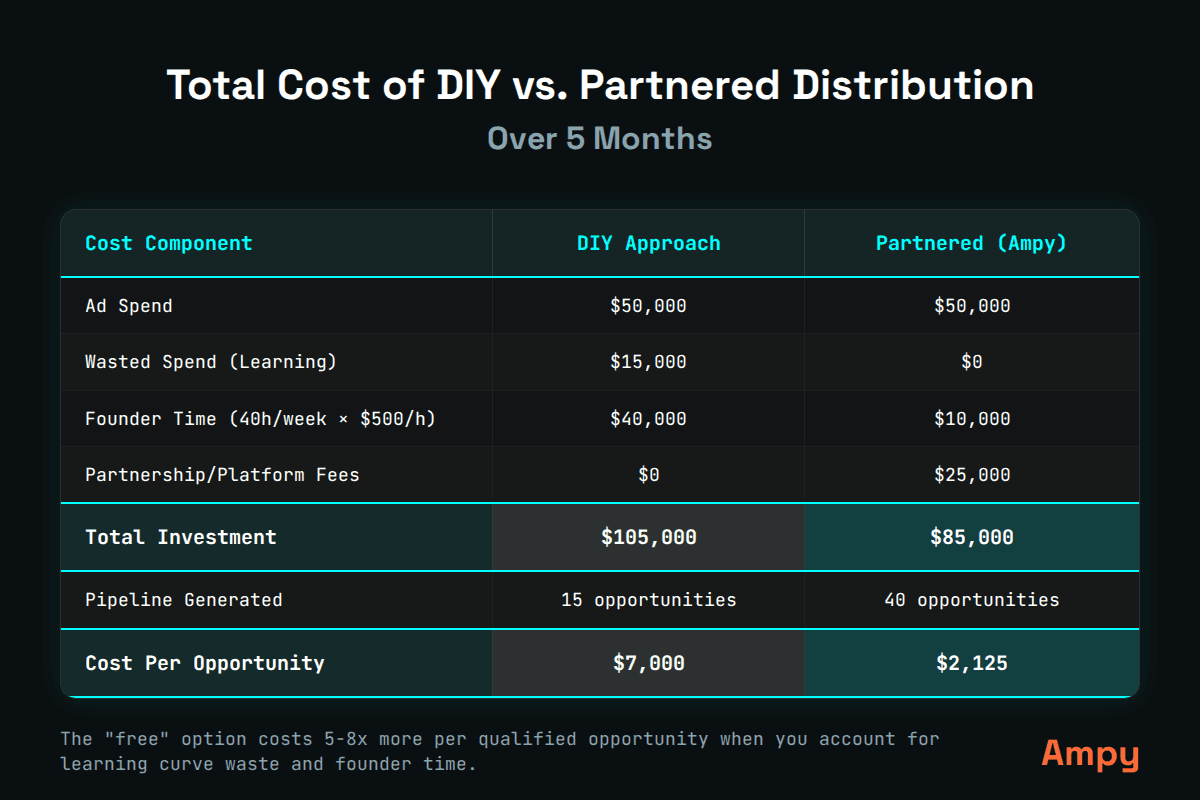
The "free" option costs 5-8x more per qualified opportunity when you account for learning curve waste and founder time.
What Changes With a Partnership Model
TL;DR: A partnership model doesn't replace the founder — it compresses the learning curve to zero, provides operational infrastructure from day one, and frees up founder time for the work only they can do (product, sales, fundraising).
Ampy's approach isn't to take distribution off your plate and disappear into a black box. That's the agency model, and we've written about why it often underdelivers. Our manual distribution ops comparison covers the operational side of this.
Instead, the model works in three phases:
Phase 1: Playbook. Karl works directly with your team to build the distribution strategy — target accounts, messaging sequence, channel mix, measurement framework. This is where twelve years of doing this at scale pays off immediately. The decisions that take a DIY founder months of testing get made in the first two weeks based on pattern recognition from hundreds of prior campaigns.
Phase 2: Mission Control. The strategy gets operationalized inside Ampy's platform. Campaign setup, audience syncing, sequencing logic, cross-platform coordination — all the infrastructure that a DIY operator would need to build from scratch is already built and running.
Phase 3: Operator. Over time, the system gets smarter. What started as Karl's expertise encoded into a playbook becomes a system that can flag when creative needs refreshing, when an audience segment is saturating, when budget should shift between channels. The trajectory moves from Karl → System → AI-assisted operations.
The founder stays involved in strategy — nobody knows your market better than you. But the operational complexity, the platform mechanics, the daily optimization — that's handled by someone who's already made those mistakes at scale and built systems to avoid them.
When DIY Actually Makes Sense
TL;DR: DIY distribution can work if you have a marketing co-founder with paid media experience, you're pre-revenue and validating messaging (not scaling), or your total addressable market is so small that manual outreach is genuinely sufficient.
This isn't a "DIY is always bad" article. There are situations where doing it yourself is the right move:
You have a marketing co-founder with real platform experience. Not "I ran some Facebook ads for my side project" experience — actual B2B paid media at scale. If someone on your founding team has managed six-figure monthly budgets across LinkedIn and Google, you have the expertise in-house. Use it.
You're still in validation mode. If you haven't nailed your ICP or core messaging yet, spending on scaled distribution is premature regardless of who's running it. At this stage, manual outreach and small-scale testing make more sense than building a distribution engine.
Your TAM is genuinely tiny. If your total addressable market is 50 companies, you probably don't need programmatic distribution. A personal email and a warm intro will get you further than any ad campaign.
For everyone else — Series A+ companies with a proven product, a defined ICP, and a need to build pipeline at scale — the DIY path has a price tag that most founders don't see until they've already paid it.
Frequently Asked Questions
How much does DIY B2B distribution actually cost per month?
Beyond ad spend (typically $5,000-$15,000/month for early-stage B2B), the real cost is founder time. Most founders underestimate this at 5 hours/week; the actual number is closer to 15-20 hours/week when you include creative production, campaign management, reporting, and troubleshooting. At opportunity cost rates, that's $30,000-$80,000/month in founder time alone.
Can I hire a junior marketer to handle distribution instead of doing it myself?
You can, but you're trading one learning curve for another. A junior marketer may cost $60,000-$80,000/year in salary, but they'll face the same ramp-up period on platforms and strategy. Forrester's 2024 data shows that marketers with under two years of B2B paid media experience generate 40-60% fewer qualified leads per dollar than experienced operators. You also need to manage them, which still costs you time.
How long before DIY distribution starts generating real pipeline?
For most B2B companies, expect three to six months before DIY distribution produces consistent qualified opportunities. The first one to two months are pure learning — platform setup, audience testing, creative iteration. Months three and four start showing early signal. Consistent pipeline typically arrives around month five or six, assuming the campaigns are actively maintained throughout. An experienced operator can compress this to four to six weeks.
What's the difference between DIY distribution and hiring an agency?
DIY means you're the operator — you run everything yourself. An agency takes over operations but often lacks deep context on your specific market, creates reporting overhead, and may not prioritize your account if you're a smaller client. A partnership model (like Ampy's) sits in between: experienced operator + purpose-built infrastructure + your strategic input. Each option trades off cost, control, and expertise differently.
Is DIY B2B distribution easier with tools like LinkedIn Campaign Manager?
Tools help, but they don't solve the strategic layer. LinkedIn Campaign Manager gives you access to targeting and bidding, but it doesn't tell you how to sequence messages over time, manage frequency across accounts, or coordinate with Google and Meta campaigns. The platform is the instrument — knowing how to play it is a different skill entirely. We break this down further in our LinkedIn Campaign Manager comparison.
Ready to skip the 6-month learning curve?
Karl partners directly with B2B teams to build distribution clarity that works — whether you want to run it yourself later or keep it partnership-based.
Get early access to Mission Control
One email. We'll reach out when your seat is ready.
Related Articles
Ampy vs. Hiring a Demand Gen Manager: The Real Cost Comparison
Compare the real cost of hiring a demand gen manager ($180K-260K) vs. Ampy's partnership model. Covers ramp time, channel risk, and when each option makes sense.
Ampy vs LinkedIn Campaign Manager: Why You Need More Than the Basics
Compare Ampy's advanced LinkedIn automation with native Campaign Manager. Learn when you need more than basic LinkedIn advertising.
What are Sequenced LinkedIn Ads?
Sequenced LinkedIn ads deliver multiple posts to the same accounts in order. Learn how to set up ad sequences that build recognition and drive higher engagement.
Karl Newlin
Founder & CEO, Ampy
Karl has seen the DIY pattern fail and succeed firsthand. At Gusto, Carta, Step, and Stripe, he's watched founders learn distribution the expensive way — and built Ampy to compress that timeline from months to weeks. His experience running distribution at companies that scaled from $30M to $150M ARR shows exactly where DIY breaks down and when partnerships accelerate growth.